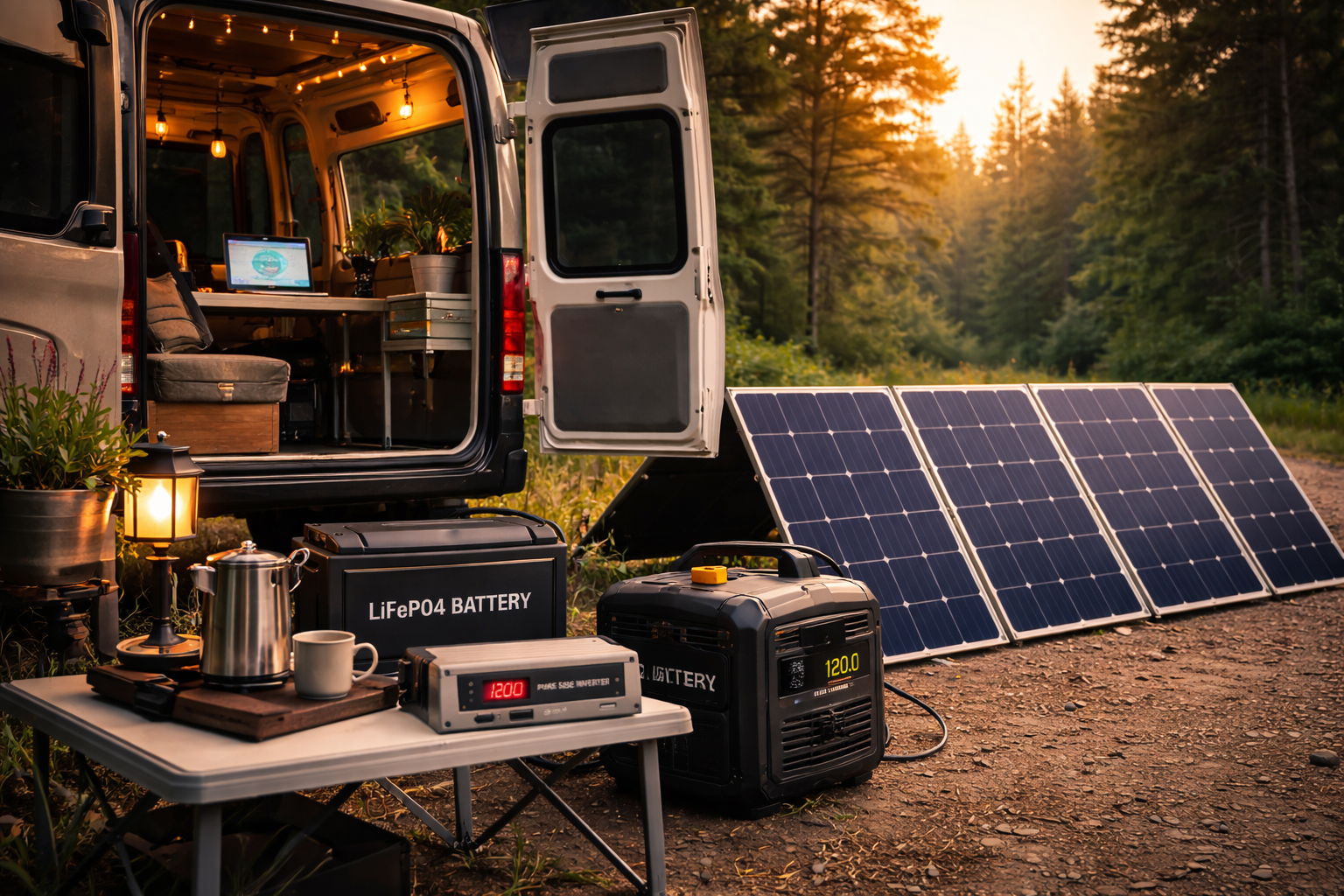
Off-Grid Power for a Mobile Workstation or Studio
Off-grid power is not about escaping reality — it’s about managing it. This guide shows how to build a reliable, conservative power setup for a mobile workstation or studio that supports refrigeration, computing, lighting, and daily routines without stress.
Scope: mobile and off-grid use only. This is not permanent home wiring. Generators are outdoor use only.
The Reality of Off-Grid Work
A productive off-grid setup usually needs to support:
- Refrigeration (food safety)
- Laptops, monitors, and peripherals
- Networking (routers, hotspots)
- Lighting
- Small appliances (coffee maker, kettle)
The mistake most people make is assuming solar alone covers everything. It doesn’t — not reliably, not year-round.
Core System Concept (What Actually Works)
The most reliable off-grid workstation uses a three-part strategy:
- Solar + battery for daily use
- Pure sine inverter for clean AC power
- Generator backup for bad weather and recovery
This is not redundancy for paranoia — it’s redundancy for productivity.
Step 1: Refrigeration (Non-Negotiable)
Food safety comes first. Portable compressor fridges are the most efficient choice off-grid.
-
Compact daily use
VEVOR 21 Qt Portable Refrigerator
Lower draw, easier to support with solar. -
Extended storage / shared space
VEVOR 115L Dual-Zone Portable Refrigerator
Higher daily energy use. Requires a stronger system.
Step 2: Battery Storage (Where Most Systems Fail)
A productive off-grid workstation typically uses 1–2 kWh per day, before refrigeration. Add more for cooking or climate control.
Practical Battery Options
-
VEVOR 24V 100Ah LiFePO₄ Battery
~2.5 kWh — minimal starting point. -
VEVOR 24V 200Ah LiFePO₄ Battery
~5 kWh — realistic multi-day buffer.
Conservative rule: size batteries for at least twice your expected daily usage.
Step 3: Clean AC Power (Protect Your Gear)
Sensitive electronics, refrigeration compressors, and appliances perform best on pure sine wave power.
-
VEVOR 5000W Pure Sine Wave Inverter Charger (24V)
Integrated charging, fewer components. -
VEVOR 4000W Pure Sine Wave Inverter (12V)
AC output only; requires separate charging.
Step 4: Solar (Daily Efficiency, Not a Guarantee)
Solar keeps you independent on good days — but weather, season, and shade matter.
Solar works best when:
- Batteries are already sized correctly
- You expect daily recharge, not instant recovery
Step 5: Generator Backup (When Reality Wins)
Even well-sized solar systems need recovery during long storms or heavy use.
-
VEVOR 4500W Quiet Inverter Generator
Strong balance of output, noise, and fuel use. -
VEVOR 4200W Dual-Fuel Inverter Generator
Fuel flexibility for longer stays.
Generators are not a failure — they are a recovery tool.
Cost vs Resilience (Real Numbers)
- Solar + battery only: $1,200–$2,500+
- Generator-only: $800–$900
- Hybrid (solar + battery + generator): highest reliability
The hybrid approach is not excess — it’s how professionals avoid downtime.
Daily Comfort Matters (Yes, Coffee Counts)
Reliable power isn’t about survival — it’s about maintaining routines. A quiet morning, a charged laptop, cold food, and hot coffee make off-grid life sustainable.
If your setup supports work, food, and rest without constant math, you’ve built it correctly.
Confidence Checklist
- I sized batteries conservatively.
- I chose pure sine power for electronics.
- I have a recovery plan for bad weather.
- I am not relying on ideal conditions.
A good off-grid system doesn’t feel impressive — it feels dependable.
