• Blog
  • Account
  • Checkout
I Am Camping
  • Camping & Hiking
  • Grills & Outdoor Cooking
  • Outdoor Recreation & Play
  • Electronics & Power
  • Hunting, Fishing & Tactical Gear
  • RVs and Trailers - Fun & Comfort
  • Outdoor Gathering & Entertaining
  • Special Offers & Bundles
  • Camping & Hiking
  • Grills & Outdoor Cooking
  • Outdoor Recreation & Play
  • Electronics & Power
  • Hunting, Fishing & Tactical Gear
  • RVs and Trailers - Fun & Comfort
  • Outdoor Gathering & Entertaining
  • Special Offers & Bundles

Shop By Category:

  • Camping & Hiking
  • Grills & Outdoor Cooking
  • Outdoor Recreation & Play
  • Electronics & Power
  • Hunting, Fishing & Tactical Gear
  • RVs and Trailers - Fun & Comfort
  • Outdoor Gathering & Entertaining
  • Special Offers & Bundles

Shop By Brand:

  • Coffee Life
  • iamcamping
  • HyperGear
  • ALL4U
  • votagoo
  • PlumChef
  • Outsunny
  • Gofort
  • Flashfish
  • Safety Technology
  • HAWOK
  • VEVOR
  • Mace
  • Griz Guard – Outdoor Survival Gear & Bear Defense Products
  • VEVOR Outdoor & Camping Gear – Durable Tents, Coolers, Tools & Accessories
  • kamperbox
  • ReadyWise
  • KORAMAN
Home > Blog > How to Scout Public Land for Hunting | Beginner Guide

How to Scout Public Land for Hunting | Beginner Guide

How to Scout Public Land for Hunting | Beginner Guide
iamcamping
March 18th, 2026

How to Scout Public Land for Hunting

One of the biggest questions new hunters ask is simple:

“Where am I supposed to hunt?”

Many people assume hunting requires private land, family property, or personal connections. While those opportunities exist, millions of acres of public land across the United States are open to hunters.

Learning how to scout public land is one of the most important skills a new hunter can develop.

This guide explains how beginners start identifying hunting locations using maps, terrain features, and wildlife sign.

What Is Public Land?

Public land is land owned and managed by federal or state governments and open for recreation, including hunting in many areas.

Some of the most common types include:

  • National Forests
  • Bureau of Land Management (BLM) land
  • State conservation areas
  • Wildlife management areas
  • State forests

In the United States, the Bureau of Land Management manages over 245 million acres of public land, much of which is open to hunting depending on local regulations.

Source: Bureau of Land Management – Hunting on Public Lands

Start With Maps

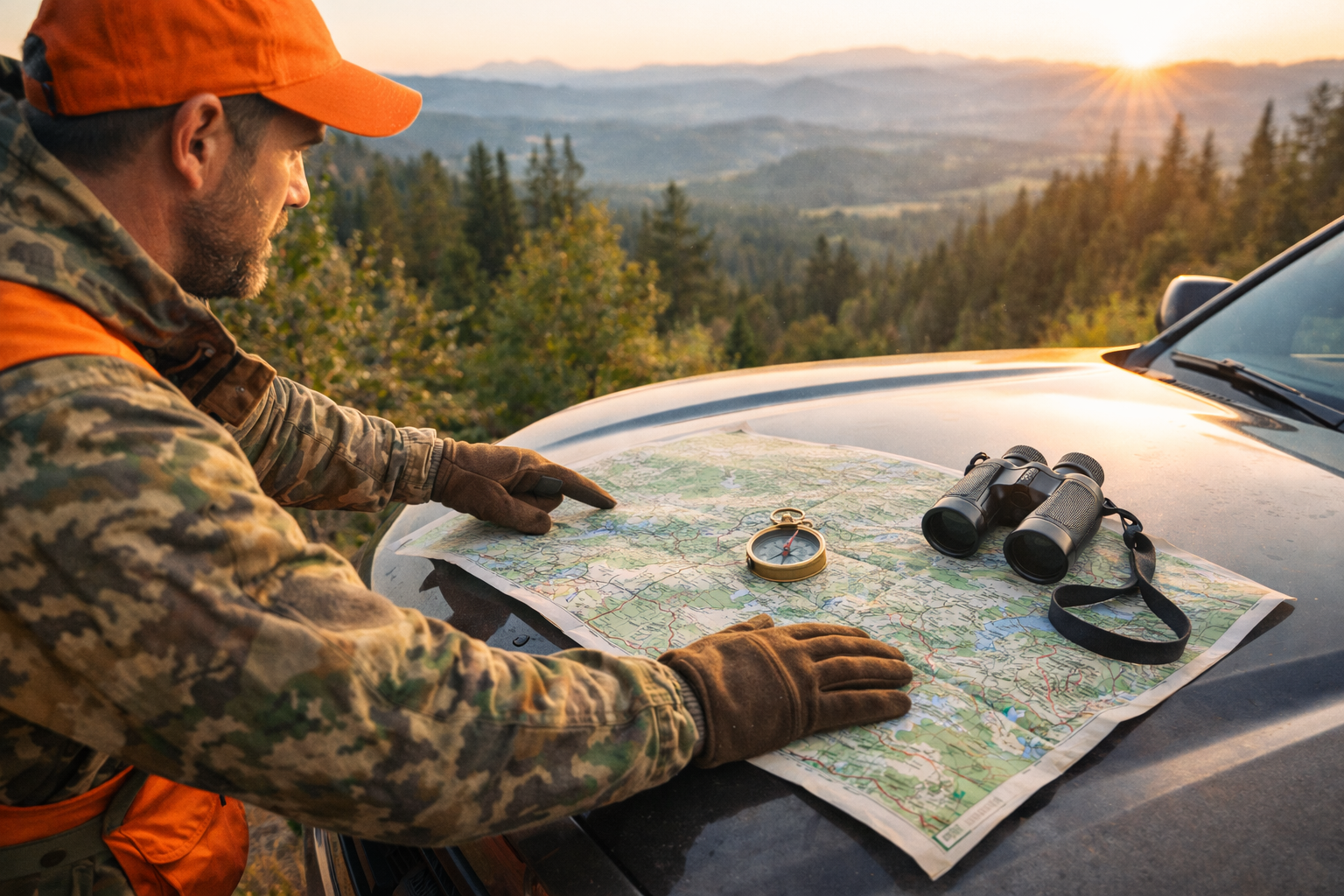
Before visiting an area in person, most hunters begin by studying maps.

Modern digital mapping tools allow hunters to identify:

  • property boundaries
  • public vs private land
  • terrain elevation
  • water sources
  • roads and access points

Many hunters use mapping applications that show public land ownership layers, but traditional topographic maps remain useful as well.

Look for Habitat, Not Just Land

Finding a place to hunt isn’t just about locating public land.

It’s about identifying habitat where animals are likely to spend time.

When studying terrain, hunters often look for:

  • water sources such as creeks and ponds
  • edges between forest and open fields
  • food sources like mast trees or agricultural areas
  • travel corridors between bedding and feeding areas

Animals move through landscapes in predictable ways, and good habitat often reveals those patterns.

Scout in Person

Digital scouting helps narrow down locations, but eventually hunters need to walk the land.

In-person scouting allows hunters to look for wildlife sign such as:

  • tracks
  • droppings
  • rubbed trees
  • scrapes
  • feeding areas
  • bedding cover

Scouting trips are often done months before a season opens.

This allows hunters to learn terrain and animal behavior without disturbing animals right before the hunt.

Example: Missouri Public Land

Missouri provides a strong example of how public land access works for hunters.

The Missouri Department of Conservation manages hundreds of conservation areas that are open to hunting during regulated seasons.

These areas vary widely in size and habitat type, ranging from forested hills to wetlands and grasslands.

Hunters can use the department’s online area maps to identify locations and review regulations for each property.

Source: Missouri Department of Conservation – Conservation Areas

Pressure and Distance

Another important factor in public land hunting is pressure.

Areas that are easy to access often receive the most hunting activity.

Many hunters increase their chances of seeing wildlife by traveling farther from roads and parking areas.

This doesn’t mean hiking miles into the wilderness every time, but even a short walk away from access points can reduce competition.

Respect the Land

Public land belongs to everyone, which means hunters share it with hikers, birdwatchers, and other outdoor users.

Responsible hunters:

  • follow local regulations
  • pack out trash
  • respect property boundaries
  • prioritize safety

Ethical behavior helps ensure hunting opportunities remain available on public land in the future.

The Skill Behind Scouting

Public land scouting is less about finding a secret location and more about learning how landscapes work.

As you gain experience, you start noticing patterns:

  • where animals feed
  • where they bed
  • how terrain funnels movement
  • how weather changes behavior

Those observations are what turn a map into a hunting location.

Next in this series: what actually happens during your first hunt.

Information

  • About Us
  • Contact Us
  • Shipping & Returns
  • Privacy Policy
  • Terms & Conditions

My Account

  • My Account
  • Order History
  • Track Orders
  • Address Book

Connect With Us

  • Twitter
  • Facebook
  • Pinterest
  • Instagram
  • Youtube

Secure Payments

© I Am Camping. All Rights Reserved.
I Am Camping Co. • 501 Boucher St., Dexter MO 63841 USA • (573) 872-1644 • support@iamcamping.com
Our website uses cookies to make your browsing experience better. By using our site you agree to our use of cookies. Learn More I Agree
× What Are Cookies As is common practice with almost all professional websites this site uses cookies, which are tiny files that are downloaded to your computer, to improve your experience. This page describes what information they gather, how we use it and why we sometimes need to store these cookies. We will also share how you can prevent these cookies from being stored however this may downgrade or 'break' certain elements of the sites functionality. For more general information on cookies see the Wikipedia article on HTTP Cookies. How We Use Cookies We use cookies for a variety of reasons detailed below. Unfortunately in most cases there are no industry standard options for disabling cookies without completely disabling the functionality and features they add to this site. It is recommended that you leave on all cookies if you are not sure whether you need them or not in case they are used to provide a service that you use. Disabling Cookies You can prevent the setting of cookies by adjusting the settings on your browser (see your browser Help for how to do this). Be aware that disabling cookies will affect the functionality of this and many other websites that you visit. Disabling cookies will usually result in also disabling certain functionality and features of the this site. Therefore it is recommended that you do not disable cookies. The Cookies We Set
Account related cookies If you create an account with us then we will use cookies for the management of the signup process and general administration. These cookies will usually be deleted when you log out however in some cases they may remain afterwards to remember your site preferences when logged out. Login related cookies We use cookies when you are logged in so that we can remember this fact. This prevents you from having to log in every single time you visit a new page. These cookies are typically removed or cleared when you log out to ensure that you can only access restricted features and areas when logged in. Form related cookies When you submit data to through a form such as those found on contact pages or comment forms cookies may be set to remember your user details for future correspondence. Site preference cookies In order to provide you with a great experience on this site we provide the functionality to set your preferences for how this site runs when you use it. In order to remember your preferences we need to set cookies so that this information can be called whenever you interact with a page is affected by your preferences.
Third Party Cookies In some special cases we also use cookies provided by trusted third parties. The following section details which third party cookies you might encounter through this site.
This site uses Google Analytics which is one of the most widespread and trusted analytics solution on the web for helping us to understand how you use the site and ways that we can improve your experience. These cookies may track things such as how long you spend on the site and the pages that you visit so we can continue to produce engaging content. For more information on Google Analytics cookies, see the official Google Analytics page. We also use social media buttons and/or plugins on this site that allow you to connect with social network in various ways. For these to work, the social networks may set cookies through our site which may be used to enhance your profile on their site, or contribute to other purposes outlined in their respective privacy policies.