Cold at 2AM? Here’s the Shoulder-Season Sleep Fix (Without Rebuilding Your Whole Kit)
If you keep waking up cold in spring or fall, your sleeping bag might not be the problem. Most 2AM cold comes from heat loss under you, drafts, or cold feet. Fix those, and sleep gets easier.
Quick question
Have you ever gone to bed feeling “fine,” and then woke up cold at 2AM?
That’s the moment most campers start thinking, “Do I need a new bag?”
And sometimes you do. And most of the time, you just need a cleaner system.
What’s really happening at 2AM
2AM cold usually shows up when your body slows down and the environment stays the same.
- Cold from below: the ground steals heat fast.
- Drafts: a little gap turns into a lot of heat loss later.
- Cold feet: once your feet are cold, sleep gets harder.
The 3-lever sleep rule
If you only remember one thing:
Warm sleep = insulation under you + draft control + warm feet.
Then you can add a comfort layer for sitting around camp.
Step 1: Fix the cold from below
If the ground is cold or damp, your bag can’t win by itself.
Two simple ways to fix it
- Go off-ground (best for car camping and basecamp).
- Build a better base with the right pad (best for backpacking).
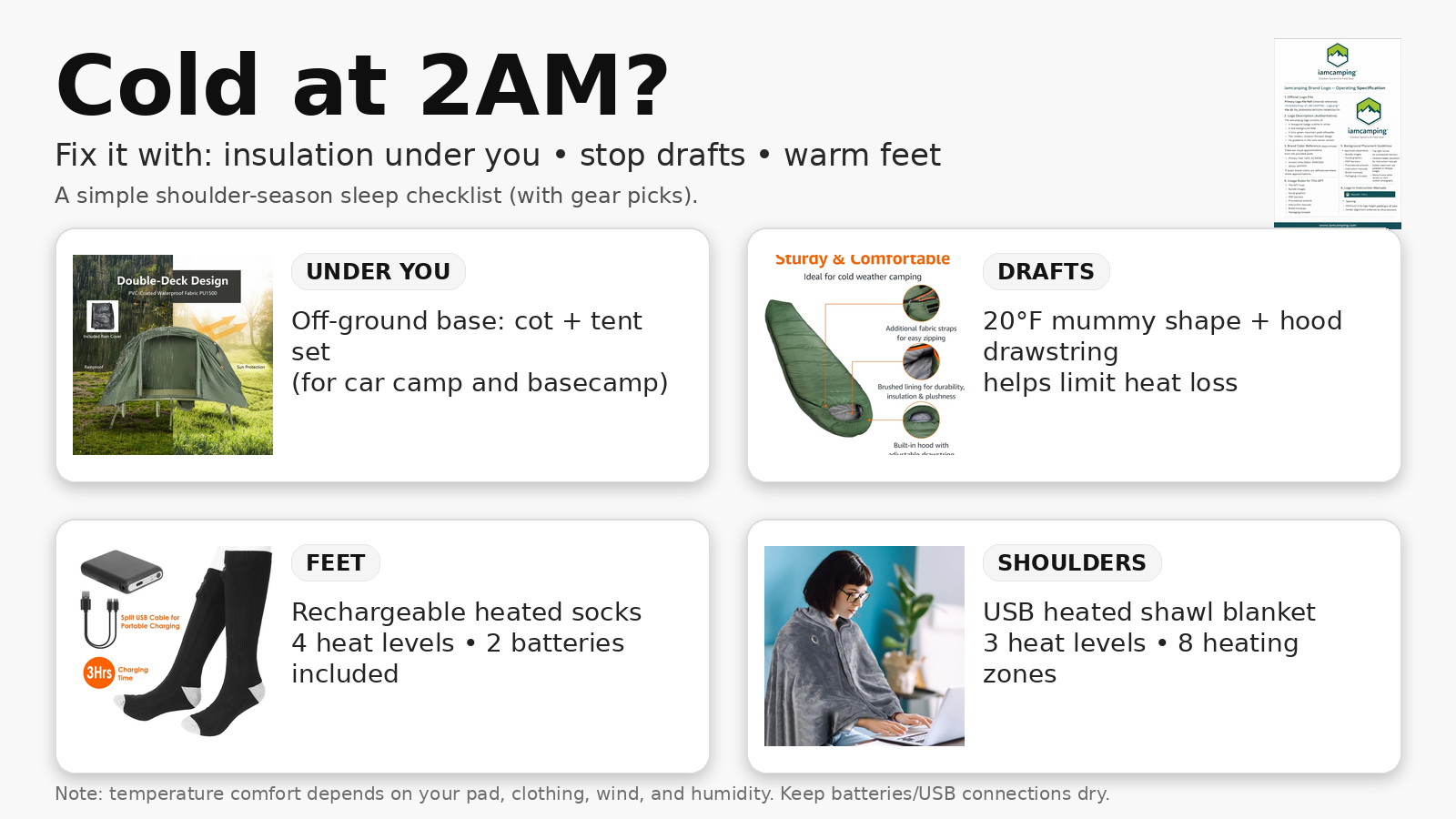
If you want an off-ground option you can use as a system, this setup combines a cot and tent:
1-Person Elevated Cot Tent Set (cot + tent + external cover + mattress)
- Set up size: 78" × 33.6" × 60"
- Net weight: 26 lb (better for car camping than backpacking)
- Max load: 330 lb
Step 2: Stop drafts before they start
Drafts often feel small at bedtime and big at 2AM.
A mummy shape helps because it reduces extra air your body has to warm up.
Here’s a simple cold-night option with a 20°F rating, a hood, and a tapered profile:
20°F Cold Weather Mummy Sleeping Bag (82" × 33", Olive Green)
- Temperature rating: 20°F (comfort varies by person and conditions)
- Size: 82" × 33"
- Design: built-in hood with adjustable drawstring
Draft check (30 seconds)
- Is your hood set and snug?
- Is your neck area sealed?
- Are you sleeping in dry layers?
- Is wind hitting the side of your shelter?
Step 3: Warm feet = easier sleep
Cold feet can ruin a good setup.
A simple fix is dry socks at bedtime. Another option is controlled heat you can adjust.
Rechargeable Heated Socks (4 levels, includes 2 battery packs)
- Heat levels: 104°F / 113°F / 131°F / 149°F
- Heating area: whole foot (front and instep)
- Listed runtime: up to 7 hrs at 104°F (and ~3 hrs at 149°F)
- Batteries: 2× 5V 5000mAh packs (included)
Real-use tip
Start on low heat and bump it up only if you need it. It’s easier to keep feet warm than to “recover” from cold feet.
Step 4: Add gentle warmth while you’re still up
Sometimes you aren’t cold in the bag. You get cold around camp first.
A warm shoulder layer can help you stay comfortable while you eat, read, or sit at a desk.
USB Heated Blanket (zippered shawl, 8 heating zones, 3 heat levels)
- Design: zipper keeps it on and lets your arms move
- Heat zones: 8 heating panels
- Heat levels: 104–140°F (3 settings)
- Power: USB 5V/2A, 8W (power bank not included)
- Size: 59" × 31"
Good to know: this is a comfort item and not a medical device.
Pick the setup that matches how you camp
Option A: Car camping / basecamp (comfort-first)
- Off-ground sleep system: 1-Person Elevated Cot Tent Set
- Cold-night bag: 20°F Mummy Sleeping Bag
- Feet warmth: Rechargeable Heated Socks
- Camp chair warmth: USB Heated Blanket Shawl
Option B: Backpacking (keep it simpler)
- 20°F Mummy Sleeping Bag (and pair it with the right sleeping pad for your temps)
- Rechargeable Heated Socks (if cold feet are your limiting factor)
- USB Heated Blanket Shawl (more of a car-camp or work-from-camp comfort item)
Note: the cot tent set is 26 lb, so it’s usually a car-camp/basecamp choice.
2AM Warm Sleep Checklist (save this)
- ✅ Dry base layers only
- ✅ Insulation under you (more than you think)
- ✅ Draft control (hood and neck area)
- ✅ Warm feet before sleep
- ✅ Vent early if you’re sweating
- ✅ Keep your sleep kit dry
Common mistakes that cause “2AM cold”
- Going to sleep in damp socks or damp base layers
- Skipping the pad or using a low-insulation pad in cold weather
- Leaving gaps at the hood/neck and letting drafts do the work
- Turning heat up too high and sweating (then getting cold)
- Waiting until your feet are already cold
Safety, comfort, and land rules
- Temperature note: Sleeping bag ratings depend on clothing, sleeping pad insulation, wind, humidity, and personal comfort.
- Powered warmth: Keep batteries and USB connections dry. Don’t use if cables or connectors are damaged. Use compatible power sources as listed on each product page.
- Leave No Trace: Follow Leave No Trace. Pack out all microtrash. Camp on durable surfaces.
- Local rules: Check local BLM/USFS/park regulations and stay limits (often 14 days).
